Transracial Adoption: Raising a Black Teen in a Mostly White Community | Kat Parvin

 Apple Podcasts
 Spotify
 Podcast Addict
 PocketCasts
 Castbox
 Castro
 What happens when a white foster-to-adopt family adopts a Black teenager in a small rural community with very little diversity?
In this deeply honest and thought-provoking episode of From Foster to Forever, Rachel talks with foster and adoptive mom Kat Parvin about transracial adoption through foster care, parenting adopted teens, navigating racism in schools, and the realities of raising a Black daughter in a predominantly white town.
Kat shares how her family’s foster care journey quickly turned into adoption after welcoming a 13-year-old girl into their home. But alongside the joy of becoming a forever family came difficult questions about racial identity, white privilege, trauma-informed parenting, and how white adoptive parents can better support Black children growing up in white spaces.
The conversation explores the emotional complexity of foster adoption, the guilt many adoptive parents feel, and the importance of listening to adoptee voices and continuing to learn — even when it’s uncomfortable.
Rachel and Kat also discuss:
- foster care disruption
- adopting older children and teens
- bullying and racism in schools
- trauma and emotional regulation
- parenting children from hard places
- supporting adopted children through identity development
- balancing the needs of biological and adopted children
- foster parenting while working full-time
- creating community and mentorship for transracially adopted children
- why representation matters in adoptive families
Kat opens up about the backlash she received online after posting about her adoption day and how that experience pushed her deeper into learning about transracial adoption, anti-racism, and culturally responsive parenting.
This episode is an important listen for:
- foster parents
- adoptive parents
- white adoptive parents
- trauma-informed caregivers
- families considering foster-to-adopt
- parents raising adopted teens
- anyone interested in foster care, adoption, racial identity, and transracial parenting
Resources Mentioned
- Do Right By Me: Learning to Raise Black Children in White Spaces
- How to Be an Antiracist by Ibram X. Kendi
- Why Are All the Black Kids Sitting Together in the Cafeteria? by Beverly Daniel Tatum
- PACT, An Adoption Alliance
- Culturally Fluent Families
About the Podcast
Hosted by award-winning audiobook narrator, writer, and foster-to-adopt mom Rachel Fulginiti, From Foster to Forever shares hopeful, honest stories of families formed through foster care and adoption. Through real conversations with foster parents, adoptees, advocates, and experts, the podcast explores the beauty, complexity, and emotional realities of nontraditional families.
🎧 Follow, rate, and review the podcast to help more foster and adoptive families discover these conversations.
#fostercare #fosteradoption #transracialadoption #adoption #adoptiveteens #adoptiveparenting #fosterparenting #whiteadoptiveparents #raisingblackchildren #racialidentity #traumainformedparenting #adoptionpodcast #fostertoadopt #adoptionjourney #fostercareawareness
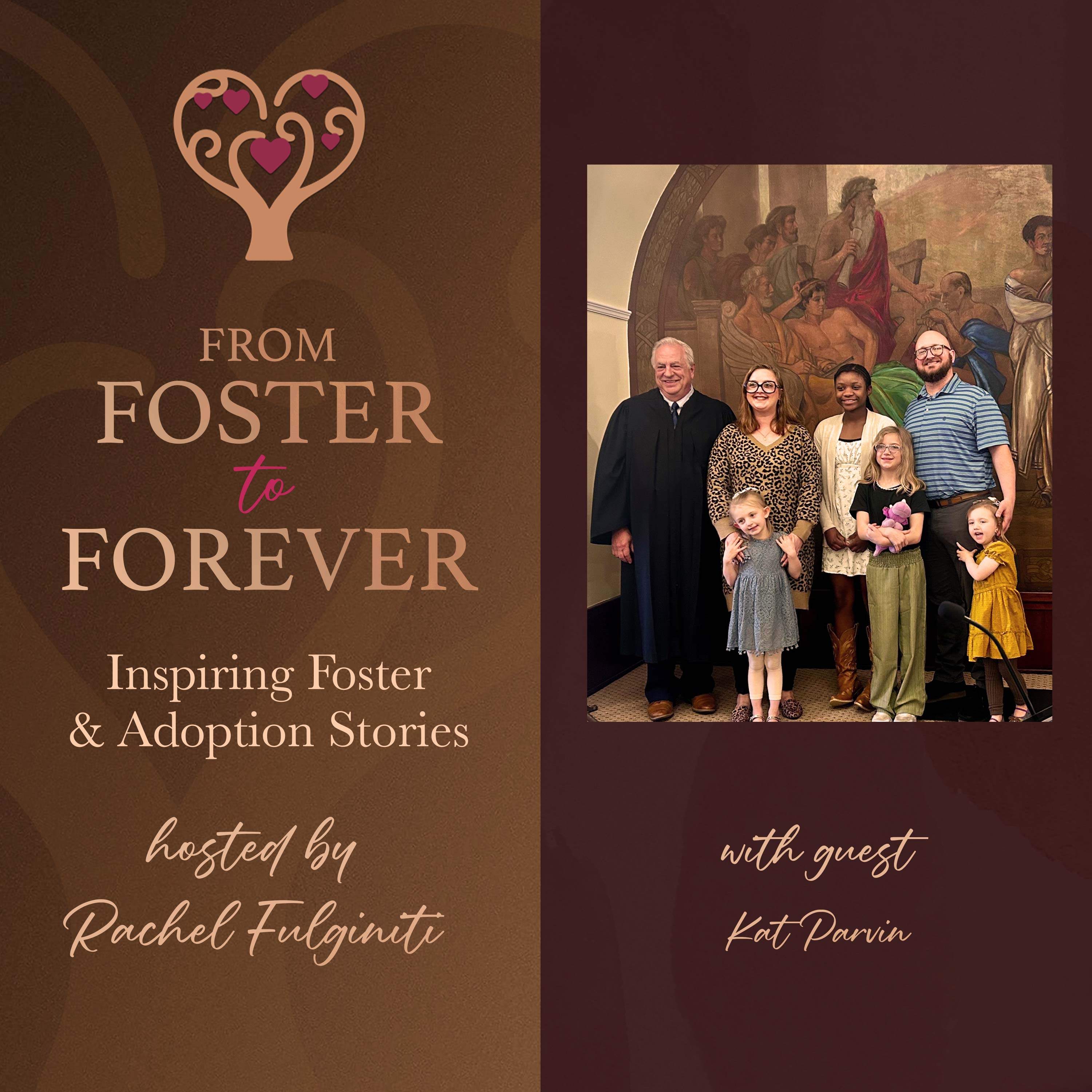
I joined this online group called Culturally Fluent Families. And rather quickly I kind of made the mistake of posting, hey, it's adoption day. We just adopted my beautiful daughter with a picture of our family.And it kind of snowballed with all the comments about how I should not have adopted a black child.
RachelIt's the Foster to Forever podcast. Happy stories of non traditional families born through Foster to Adopt. I'm your host, Rachel Fulgenetti.
RachelWelcome to the show. I'm so very happy to introduce our guest for today, Kat Parvin. Kat is a transracial adoptive mom through foster care.Really happy to talk to you today. Thanks, Kat, for coming.
KatYeah, thank you for inviting me.
RachelWhat brought you to foster care?
KatI've always wanted to be a foster parent since I was probably a teenager. I had a lot of friends that kind of had some rough upbringing and they would always stay the night at my mom's house with us.And I kind of just felt like it was something I wanted to do.
RachelWhere did you grow up?
KatI grew up in Indiana. I'm actually my husband and I and our family, we just moved back a small town called Brazil, Indiana. We just moved back there in January.
RachelHow's that feel?
KatIt's strange being back there. I've been in Terre Haute, which is only 20 minutes away, for the past 10 years or so, but I've moved different states.I grew up between Indiana and Connecticut where my dad had lived. So I've kind of moved around a lot and just decided, you know, we'd end up here. So.
RachelSo I moved back to the Hudson Valley of New York where I grew up after being in LA for 20 years. So I, I know what that's like to coming back to a place. So tell me about your family. How many children do you have and how did they come to you?
KatOkay, so my youngest, two Peregrine is three and a half, Calliope is five and a half. And then my next child, Lillian, she's eight and a half and she, Lillian is from a previous marriage, so we have a blended family.And then our oldest daughter, Minecian, she goes by Mo and she is just about to turn 14. We have three biological and one adopted.
RachelHow did you decide to do foster care?
KatMy husband and I, back when we were dating, before we were married, we kind of talked about it just because it's something I was interested in. In my previous marriage. We actually, my ex husband, Lillian's dad and I, we fostered briefly and then when he and I got divorced, we.I stopped fostering.But Then a few years later when I got remarried, then we kind of just decided we were done having our biological children and maybe it would be a good time to start fostering. So we did the whole process, all the classes, the home studies and everything last year and got our first placements in August.
RachelHow was it for your biological children? What did they think of it? Were they involved in the decision at all?
KatYeah. So the two littles, they're kind of just down for whatever. They like people, so, yeah, they like having more people in the house.Lillian was okay with it. She, again, she's eight and a half, but she. She specifically wanted a brother.And I said we don't really get to pick, just, you know, like whatever the need will be, so. But they've been pretty good with it.
RachelGreat. And so how old was the child when they were placed with you?
KatOur first placement was 16. And then a week later we got minecia, who was 13.
RachelAnd then the 16 year old didn't stay or.
KatNo, she. She left in February. Our story with MO is actually like, relatively smooth going.We got her in August, and by February, our attorney filed for a petition to adopt. The TPR was already completed before she came into our home.And so they basically, DCS was on board, the CASA was on board, and they just set the hearing for April 10 and the rest is history.
RachelWow. And so. And then you just adopted on April 10th. That is incredibly fast. That's really wonderful. Yeah.How has it been having a teenager come to you, you know, as a teenager and I'm assuming so. So she's the oldest now in the family.It's interesting because a lot of people advocate for keeping birth order, and so I'm curious about your thoughts about that and how that has affected your family dynamic.
KatI didn't really get super into the birth order thing. I did actually recently listen to your podcast on that. We already had little and you know, as you know, that's a lot of work.
RachelSo, yeah,.
KatTeenagers are in their own way, but we kind of really had a heart for an older child. And the. All of our kids seem to get on really well with older kids, so we thought we would give it a shot and see if that worked out.
RachelA lot of people have reservations about, like bringing a teenager in. I know a lot of people have also done it very successfully, but just wondering what that was like. How has it been?
KatYeah, that's a really good question. So she came from about three and a half hours away and we just had. I had talked to her previous Foster mom who we're all still really close with.They're a great support. I talked with her quite a bit. I had one video call with Mo and that was it before she came.But she's, you know, she's, she's 13, so she's kind of like right at that cusp of becoming a teenager and likes teenager things, you know, air quotes. But she's, she's still a little bit of a kid, but she's very mature in some ways at the same time. And she does have some emotional needs.There's, you know, there's some kind of blow ups and anger, but it's, you know, fortunately nothing crazy. When people are in our house, they say, yeah, that sounds like their sisters, you know, but it's been, it's been really great actually.I feel that I can really, I can talk to her and involve her in like family decisions and household decisions, which I try to do as much as possible because you know, she's not a little child and she give her input and so I think that she feels valued in that.
RachelSure.
RachelAnd so she had to, if she was coming from three and a half hours away, she obviously had to change schools and all of that. How was that transition and did you already have familiarity with the school that she attended?
KatNo. So I, I had, I didn't have anyone who attended there. I do have a friend who's a teacher at that school, but she, she had a hard time there.Like I mentioned, we are from a small rural area, very red area, and there's a lot of, I'd say pervasive racism around. And so she's had some issues at her old school.And then when we moved to Brazil a couple months later, because we moved just in January, there are even fewer black peers for her. She's made a lot of really good girlfriends, which is nice. And she has some friends who are biracial.But she still has commented to me, she says, you know, I'm the only black, black student here and there have been incidents with that repeatedly with, with boys in her grade.So she's doing really well at the academic portion and she joined some sports teams and she seems really happy with her girlfriend, but there is that pretty consistent bullying as well.
RachelOh man, that's so rough. Kat and I met for the listeners online bonding online about transracial adoption.And Kat had this cool post about all the books that she was reading and, and like educating herself as a white parent of a black child. And I have read some of those books and other Ones are on the list for sure.And I just admired so much your, you know, your commitment to educating yourself. I'm wondering how that education is going. Does your husband share that also with you?Is he also doing that work or is it just you and how has it changed your perspective?
KatGood questions. So I would kind of start from the very beginning. I grew up in this area, but my mom is a sociologist.She's a College professor at St. Mary of the Woods College. And so I kind of grew up with learning some of this knowledge, going to classes with my mom. And it's just. That's her passion.It has kind of become my passion. So some of the books were already kind of on my to read list.But I will say that having MO in our home definitely, like, promulgated me to, you know, get to them. Get to some of these books a little more quickly. And I would say some of them were recommended specifically for transracial adoption.Some were just books I had on my list, like how to Be an Anti Racist by Ibram Kendi. I joined this online group called Culturally Fluent Families. And rather quickly, I kind of made the mistake of posting, hey, it's adoption day.We just adopted my beautiful daughter with a picture of our family. And it kind of snowballed with all the comments about how I should not have adopted a black child.
RachelAha. So you posted and didn't really think about it, and then you received all this backlash.
KatYes. While I've tried to be an educated person about race and the status of that in our.In our society, what I had not experience with is the actual adoption and transracial adoption, you know, and several people were like, you should have thought of this beforehand. You know, things like that. And, you know, it was kind of a slap in the face. But, I mean, there was some very constructive criticism.And, you know, there were. It's just shocking that it's not really a requirement to have more training on transracial adoption.
RachelYeah.
KatBecause even. Even in our homogenous, very white area, there was a black child. So I just.It floors me that there wasn't required training on that and recommended reading, probably.
RachelBecause we did our fostering and adoption in Los Angeles.And it was very much a part of the conversation from the very beginning of our training was, you know, if you are saying that you are willing to adopt a child of a different ethnicity than you, how. How are you going to support that child? Do you have a friend group that represents them? Do you. Are, you know, what is your.The makeup of your Neighborhood, the school, all of the stuff that made us really think a lot about that. And what I'm hearing you say is that there wasn't really that kind of training or support up front. They didn't discuss that aspect.It was kind of just like, did they ask you if you were open to different races? And then you just kind of were like, yeah, of course. And then that was it.
KatYeah. So, yeah, that's. We kind of were just like whatever the need is. They. They did ask and they being most care team, whole team.We had, you know, some conference calls.They did ask a little bit about how we would, you know, try to support her, but it was very, very, like, general answers, you know, like, we want to, you know, visit black churches, for example, although we do have a home church that we're members are more deacons at. And our. Our church is largely a white light congregation, but it does have aspects of social justice.I have a social justice club, but really, I mean, you know, it's kind of like, yes, I have some black friends. They don't all live around here. Right. I don't know how, you know, that is.
RachelRight. So how do you. How are you handling it? Because where you live is. This area is. It's just not a diverse area. It sounds like, how do you.How can you handle this? You know, what do you. What do you do?
KatWell, I'm struggling to be completely honest with you, but the number one thing that we've actually successfully been able to do is make sure that Mel has a black hair stylist. And that's important. I have been researching different things. There's a program in Indianapolis and it's the Delta Gems.So it's a sorority and it's a program for black high school girls, and it's something that they have to apply for. So in the fall. I've talked to Mo about it and she said that she was interested, so she's going to apply for that in the fall.And so if that goes through, then she will be going. We'll take her to Indy once a month for them to meet and, you know, prepare for college and things like that.Otherwise, my mentor from law school, her name is Keisha and she is an attorney and she's a magistrate in the Dayton, Ohio area.And so Mo and I are going to take a little day or two trip to, to kind of job shadow her and see, you know, her professional life and then, you know, stay the night with her.And then I've learned that there's something called the Black Expo also in Indianapolis and they do a summer celebration with a ton of black owned businesses. There's a modeling show which I'm excited to take Motu because she's into modeling and things like that and just a bunch of different activities.So I've been trying to keep my eyes peeled for things like that.We do have to travel a little bit about an hour to get to Indianapolis, but I know that there's more available, like the community around here is good.So I'm kind of trying to reach out to people and see if there's any kind of mentor group or just a group of peers or things like that that she could spend some time with too.
RachelYeah. Yeah. Good. I mean it's, it's great that you're doing what you can.Going back to that moment when you weren't expecting that kind of response when you said that you were had adopted, you were happy and excited and joyful, I'm sure. And to receive that kind of backlash, like just take me back to that and how did you handle that and, and reconcile that.
KatI was really upset. I didn't cry, but I was just taken aback. A part of me could understand, like we didn't make a huge deal out of adoption day.I did let Lillian and Mo stay home from school and then we had a nice lunch after. But part of me recognizes that while we are very excited for the adoption day and I think Mo was excited to be out of the foster system for sure.But you know, the fact that adoption means loss, it just does. And so you know that that was something they kind of brought up in the group too.So the Facebook group though, they have courses that you can pay for about different things and I did sign up for one regarding racial identity development. So I've kind of started that. And I think it's, it's like a self paced class that you get a booklet and kind of go through that.So I've been doing that as well, but I just haven't, otherwise I haven't commented.I've more so just listened and read through things, you know, both as a white person and also as like an adoptive mom trying to focus more on adoptees voices and black voices or people of color.And just also I, you know, I've talked with some trusted friends about the situation and I talked to Mo's last foster mom and she's a black woman as well. And so everyone has their, their opinions on it, but I think, I think getting a wide range of trusted opinions has kind of helped me Deal with it.But I just. I do. I have guilt. I have. I probably have white guilt, but I. I also have guilt surrounding not being more prepared ahead of time.But guilt's not productive. So that's why I decided I. I have my notebooks I keep. So I've. I've been taking notes and trying to research more and things like.
RachelRight.
KatYeah. And I talked to. I try to talk to Mo about race, and sometimes she just rolls her eyes at me and she's like, I knew I was going to a white family.I had some say. I knew what I signed up for. That's what she told me.
RachelOkay.
KatAnd I told her, I said, I know that, but, you know, I always want to talk when she's like, why are you reading all those books? You know, I'm just trying to learn. I actually gave her a copy of how to Be an Anti Racist just because I thought it was so good.I don't need to read this. I said, you don't have to. But, yeah, available.
RachelYeah. Kind of like the puberty book that I gave my kid. She's like, I'm too young for this. I was like, okay, well, it's here. It's here.If you feel like you're interested and you want to know about it. Yeah, I mean, you know, we. We don't know what we don't know. Right. And so we can't. You know, you were doing the best you could.And the reality is, I mean, there's.There's also the reality that, like, had you not adopted her, somebody else who's not as, like, willing to check their privilege and look at their whiteness and do all the work might have adopted her, and that might have even been worse. So, like, in those areas, I know a lot of people are super against, like, transracial adoption, but I've also heard it brought up.I mean, if it's a super white area and there aren't a lot of black foster families or, you know, willing to adopt or whatever it is able to adopt, then what's the alternative? So there's also that, you know.
KatYeah, yeah, that's a good point. She. I know that she. She probably would hate me talking about it, but, I mean, she'd been in foster care for, I don't know, like, four years maybe.And I think we were her seventh home. So I just, you know, I don't know. The first time I saw her picture, it really spoke to me, and I just.I was like, you know, we'll give it a shot, but she's, it's funny because her personality is really quirky and, and silly and she makes a lot of jokes and one of my childhood friends was over and said, she's just like you when you were little. And I just started laughing and I thought, you know, that's kind of true, we are kind of similar.
RachelBut uh huh, yeah, I love that. I always find I had an acupuncturist tell me this so long ago when I was trying to get pregnant naturally like a million years ago.And she was like, somehow everyone ends up with the right kid. Like they just. Everyone ends up with the right child.And you know, I just, there is something to be said for that sort of magical thing that just happens that fits. I feel like, you know, and maybe that is just a function of, you know, them being in your family and you forming that bond and that just happens.But I do think like my kids the same, like they're just so, like perfectly perfect for us in our family. Yeah, yeah, yeah, yeah.
KatI think Mo fits in wonderfully. And it does, it does feel like it was meant to be.
RachelHow is your husband handling the race piece?
KatSo he acknowledges it and he listens when she talks about things at school, although she does talk to me about that stuff more often. I tend to consume books very quickly. It's probably my only hobby.So he's, he hasn't read all the books, but he lets me talk to the, you know, I talk to him about the books and different things or some of them. I do audiobooks. So if he and I are together, I'll sometimes turn him on and he'll listen and get some discussion about it.So he's definitely not colorblind. He understands his male white privilege.I think it's tough for him though, because, you know, I can empathize with being bullied as I was bullied a lot. I don't. He has a thicker skin and kind of lets things roll off of him.So his attitude is kind of more like, well, we've got to find ways to cope with it and deal with it because it keeps happening. So I kind of feel like between the two of us, she gets some good advice.
RachelHow is the school responding to the bullying?
KatOh, well, one time I called and it's hard sometimes to drag the information out of Mo because, you know, when, sometimes when parents get involved, then, you know, they called her a snitch. Yeah. So I talked to the dean of the school once and they said that they would handle it.I think the kid got like A lunch detention, which I don't think is appropriate, but that's my opinion. And then otherwise, there was a video that happened outside of school.So even though she was upset about it while she was at school, they said, you know, they couldn't really do anything about it because it didn't happen at school. I. I've talked with them some, and they're like, she has to report it. So that's.That's been the big struggle is she's like, I don't want to report it all the time. And I said, honestly, you shouldn't have to. But I told her that she should because they recorded at least.And if it's the same kids, you know, and there's multiple incidents, then it should be more than something like a lunch detention.
RachelYeah. It's verbal abuse or.
KatOkay, yeah.
RachelYeah. You know, you would think that they would be addressing it even on a school level, like a. Like a. This is our community, and we need to address this.But, yeah, I guess they have their curriculum and their things that they're, you know, and they're not prioritizing that type of thing.
KatYeah. And part of me wants to. To say, you know, you need to have a school assembly to address some of this. I don't know what.All training teachers have to go through an admin as far as sensitivity training and things like that. But, I mean. And then a part of me is, you know, the last day of school is tomorrow, so. Yeah, but she doesn't. Even. Half of her doesn't.She's like, I kind of want to homeschool school. She really wants me to look into it because she's like, I'm just. She already has. Like, she has an IEP for emotional things. And so she's been.And I told her this. I said, you've been really good at handling it. Again, not that you should have to.
RachelRight. Yeah.
KatBut at controlling her anger and things. I mean, she's done a remarkable job, but she kind of wants to homeschool. And so I need to research all that, but it's been. It's been tough.And then trying to find people's parents, basically, I, like, hunt people down on Facebook and say, hey, our kids go to school together, and your kid is saying racist stuff to my daughter, and it doesn't make warm and fuzzies for people. So that's not good for you.
RachelYeah. Are they responding well to that, or. They.
KatI think most of the parents have said things like, we absolutely don't tolerate that, and we don't we don't speak that way. Like, we'll talk to them. One child, I think their parent probably made them. They wrote an apology and made it into a video and sent it to Mo.An apology video.
RachelAll right.
KatSomething. I guess there was one dad that was pretty defensive, but I kind of just stuck to it and said, yeah, but it's racist, so.
RachelMm. Yeah. It's so interesting that, like, how your perspective changes when you have a black child.It's just, you know, you can go through life, like, completely unaware as a white person and just be like, oh, no, it's. You know, it's pretty. Pretty much like, there's not really a lot of racism around or, like, you know what I mean?And you could just be in that bubble, but when your child is right there in front of you, I mean, suddenly every. You just see everything from such a different lens, you know? Totally.
KatIt makes me, like, question it. I'm pretty outspoken, even when it scares me. I. I've been an outspoken person.But it does make me wonder, like, how many times have I been complicit and just not even realized it.
RachelYeah. Yep, yep. And.And for all those kids at school, I mean, what a learning opportunity is there for someone to come in and address this and talk about that. Talk about being quiet, being silent, and how that's being complicit as well, and. And all of that. That stuff. Do her.I'm assuming her girlfriends are white. Do they stick up for her? Do they.
KatMost of them are white. She does have a couple. She has three, I think, kind of close friends that are biracial. And I have.I speak pretty frequently to one of their moms and a little bit to one of the other moms. And, um. But it's shown me that Mo's not the only one that the kids have been bothering and have said things to.And I. I think that they kind of stick up for her. But I. I told her, I said, you know, if your friends just sit there, like, that's not okay either.
RachelI know.
KatI know no one wants to be confrontational, and I know everyone wants to just kind of appease everybody and. And have some harmony, but that's not okay either. It's everybody's responsibility.
RachelYeah. Does she have any contact with her birth family at all?
KatNo. So the situation. She didn't really have contact with her birth father and then her birth mother. It was a little bit of a dangerous situation.And so they don't have contact. But I. Mo has some social media, and I think her mom, she told me her mom like tried to contact her and she just blocked her.But we do know like who you know since, since she was older when she came into foster care. She really know like, knows her mom and everything.So, you know, maybe when she's older it might be appropriate at that point for them to, to maybe have a relationship. Right now. It's just not safe.
RachelYeah, no, that makes sense. What will she do for the summer? What are your summer plans for her? Is, is there camp? Is there.
KatWhat's.
RachelWhat happens in the summer?
KatThis will be our first summer really. So one week she's going to like a sleep away camp in upstate.I'm really excited for her and she's like, I can't have my phone for a week but, but I think she'll have, she's like, I don't have any friends there. And I said that's half the point of camp is meeting new people. But it was suggested to me by one of my friends.Her kids go there and she said it's, it's much more diverse and so, you know, that might be something good for her. So we're gonna try that. Right. And then she's hoping that we can find some kind of basketball related things to do.
RachelMm, good. Yeah.Very, very good friend of mine is black and she grew up in Rhode island and said that she really was not around black people except for the summers because she went to. And that's I think why it just dawned on me to ask that question because she went to a camp that was pretty much all black.And so every summer she's like, that's how I basically learned how to be black, like in my, in my summer camp experience until she was a teenager and then they moved. But yeah, it's just finding those opportunities I think can be really valuable. There's also transracial adoption camps. Have you heard of those?Like Pact is one of them.
KatI need to do some more research.
RachelAnd they just sound like really great. It's for the whole family. I think it's a great opportunity and I know they do have some scholarships and that kind of thing too. So.Yeah, it's worth looking into for sure. I can link to, to it in the show notes.
KatYeah, I would love that.
RachelYeah.
KatYeah, that sounds like fun.
RachelRight? What are some of the, the books that you've read so far that have made the most profound impact on you?
KatWell, I'm. Right now I'm reading this called Do Right by Me. Okay. By Valerie Harrison and Catherine Peach. D' Angelo.And just kind of about 20 through it, I'd say. And it's Learning to Raise black kids in White Spaces. Pretty good so far.
RachelOkay.
KatAnd then the Angela Tucker book is really good. And I can. Yeah, I had it on a Word document, but.And then this book doesn't specifically have to do with transracial adoption, but I think it's very important. I think it's important for anyone is why are all the black kids sitting together in the cafeteria?And that book was actually written, I think, 20 years ago, but the. I actually listened to it on audiobook, and so it had the updated forward and everything, which is actually important to the book.So it's really good.
RachelOh, great. I'm an audiobook listener, too. I'm an audiobook narrator, so. But I listen, too. I love listening. So, yeah, I will check that out for sure.And, you know, as I said, we'll link to those resources.
KatYeah, there's a lot on audiobook, actually. This Do Right by Me is one I could not find, so I bought the paper copy, so it'll take me a little longer to read, but yeah. And the.Why are all the black kids sitting together in the cafeteria? The author is Tatum. And that's just. It's really good and.
RachelOkay, great. What has surprised you about your journey so far in with foster care and adoption? Besides obviously the racial piece, which was a surprise.It sounds like a little bit of.
KatA little bit of a surprise there. We had with the foster journey. I kind of had a clue of what it was like because I'd done it previously, but just for a bit. The second go around.We went through an agency and I thought, you know, this is recommended. Everybody says use an agency, but it almost.Some of it was helpful, but some of it was just kind of like double time with the, you know, having more people in the house.
RachelYes. And more social work visits. And. Yeah. Yeah.
KatBecause we. They would have to. For one child. She had to come twice a week even.And then, you know, you got to be prepared for the services, which are time consuming. Just, you know, we were really fortunate for Mo's. She had life skills coaching and she had a therapist that both did home visits.So we were really lucky that they were able to do that. But it was. It was a hard thing to swallow that, like, not every kid is going to fit. Our first placement we ended up disrupting in February.She was 16 and. And I have love for her, but yeah, I was not a good fit for our home, the whole situation. And so that Was it was surprising.Just like I have mental health issues and so I kind of take that as well as a learning tool, my experience and think, you know, oh, I can help other people and the kids that might have similar issues, but that's not always the case. So sometimes they need some help that I can give.
RachelYeah. So it was your decision to, to disrupt that placement?
KatIt was, yeah.
RachelYeah. How did your family react or respond to it? What did it.Had it been impacting your biological family in a way that you were like, I have to change this right now or I'm just curious. I, I think it's helpful sometimes for listeners, even though it's painful.Helpful for people to listen to the decision making process and what went into it and in case they're experiencing something similar.
KatYeah.So like I've mentioned, I do have littles and they were kind of attached to her, but she started cutting a bunch more and a couple times overdosed on medication.And the final time the, I was on an airplane and got the call from the nanny and it was just a regular morning that she was supposed to get up and go to school. And long story short, like the police and the ambulance had to come and my littles were there and that kind of thing is just scary for them.
RachelYeah, absolutely.
KatAnd it got to be too, you know, my husband and I both work full time. She is just, she was someone who needed 247 supervision. So.
RachelYeah.
KatAnd she would sometimes skip school. And then one day I just have to call the agency and say someone's gonna have to go there because I cannot miss any more work.And that's, you know, that's kind of the reality of it. It's, it's, it might be, I don't want to say easy because it's never easy, but it might be, you know, beneficial.I think that's why there's probably a lot of homes where there is a stay at home parent retiree, for example. So, So I mean, I think those are good things to ask about whenever you might be receiving a child into your home.
RachelYeah, it's difficult because a lot of people that I've talked to when they've had those like more extreme situations, usually with teenagers, which is understandable for sure. They weren't necessarily given a heads up ahead of time about how deep this, the, the issues were or potential problems or anything like that.And I, I, you know, I can see in the one case it's like, well, they're trying to place this child and they want to, they, they need A home for this child. But on the other hand, it's like to hold information back is, is not ethical.Did you feel that you were prepared, like, did you understand, you know, much about her when you brought her into the home or was it sort of like, oh wow, this is not, this is like way beyond what we were prepared to deal with.
KatIt was yes and no. I mean, they told us that she had been moved for suicidal ideation.At the same time it kind of sounded like it maybe had been a one off situation where not so recurring. And, and I talked to her previous foster parent as well and she said, oh, she wouldn't pull that here. And she, I wouldn't let her miss school.And I'm thinking, you know, like I'm, I'm pretty like laissez faire with my kids and I mean I make them go to school. But what are you really going to do with a 16 year old? It's not like my 5 year old that I can pick her up and put her in a car seat and.
RachelSay, hey, right, true.
KatI'm not gonna, you know, physically like drag her or something like that.
RachelYeah.
KatYou know, so it's, you know, if she says she's not going to school, we go back and forth. My option was to call the agency. They're like, well, we can't do this all the time. I can't do this all the time either.
RachelYeah, yeah. Were you able to keep in touch with her or was it just better to. To not do that?
KatI asked the agency worker, you know, if, if she had a phone, if she wanted to have contact, but I just never really heard back. So my assumption was, my assumption was that she probably just didn't want to. So she's always welcome to contact us or come visit if she wanted to.But you know, if she doesn't want to, I want to respect that too. So.
RachelSure.
RachelYou're juggling a lot. You said you are working full time. You have littles and you have a teenage adopted daughter, an older child as well. How do you manage everything?How do you handle everything without like being just completely crazy or you know, exhausted all the time or are you just, can you talk to us about that?
KatI'd say I don't know that I do handle it all the time. I, There's a lot of, I think it's, I call it happy chaos.Our house is chaotic and that's another reason I think not necessarily every kiddo would, would want to necessarily be there, you know, with the littles and all. The chaos. We do have our version of structure that does help.So all the kids know Sunday morning we're going to go to church and they know, you know, Thursday afternoons they're going to have dance and you know, they know the schedule as well as possible, so that helps. It gets more difficult when there are more activities in the loop.But I would also point out that I'm not a single parent and my husband is very helpful. He does a lot of the transportation after work and so kind of dividing and conquering has, has been the case.And you know, he does a lot of the cooking and yeah, he does a lot to help.
RachelThat's great. Yeah, yeah, yeah. And do you ever feel like, because your, your child, your adopted child needs a lot of attention that you're.Do you ever feel bad of like, oh, but my Littles need like all this attention in a different way. But I have to give so much attention to Mo. How does that feel? I mean, I. Just curious.
KatYeah, I mentioned earlier I'm kind of. I'm kind of a guilty person by trade. But yeah, I mean the Littles need a lot of attention.Mo has separate teenager issues and then Lillian, who is the eight and a half year old, she has ADHD and has an outburst. And so, yeah, someone is always needing something.
RachelYes.
KatKind of the nature of kids, you know. But I just try really hard to spend.I don't really do a lot of one on one time, but I'll make sure if I need to like run somewhere that I'll say, hey Mo, want to go for a ride with me and bring her or you know, some of them, like with Grammy, my mom, they might. She tries to kind of divide things too and like have one at a time for a little bit.And so that's helpful because it is hard kind of being pulled in all the directions. It usually ends up like at night around 8 o', clock, 7:30, 8 o', clock when I'm trying to put the Littles to bed.Everyone is, is in our bed at some point, even. Even though it's the teenager. Yeah. So she's like, you know, and that's when she'll start talking about her day more.And we try to eat meals together, but even that's hectic sometimes, so.
RachelYeah, yeah, it is. I appreciate your honesty. It's challenging even for us. And we only have two, but my daughter is 10 with ADHD and autism and my son is four.He'll be five in July.And so that, that age difference is difficult too because they're not going to the exact same activities and they're not even wanting to do the same things or play the. You know, so it does. It gets challenging. As he's getting a little bit older, it's starting to get a little bit easier.And like, he used to really drive her crazy because he's so all over the place and, like, really, really active.And, you know, she doesn't like the unpredictability of him and like, where he is in space and if he's knocking down her thing that she's building or like, whatever it is. As they're getting older, they're becoming more. They're playing more, which I really love. And I just want to see that continue on.This past Sunday, Joe and I, my husband actually, and I actually got to take a nap, a short nap on the couch while the two of them played outside in the sprinkler, like in the yard. And we were just like, wow, that is something that has never happened. And that was exciting.Kat, it's been so great talking with you and I just want to say, like, you're doing a great job. You're doing a great job and you. And you have nothing to feel guilty about. Like, honestly, like, I get it and I get why you're saying that.And like, I. But like, you're doing the work. Your heart is in the right place. You're doing the work. You're educating yourself. I think.I think you're doing a good job. That's all I want to say.
KatThank you. I really appreciate that. Yeah.
RachelYeah. And I appreciate. I know. Me too. And don't be a stranger. Let's stay in touch. And I think we need each other.I think it's important for people who are in this experience who have traveled this road to form connections and stay in touch because things get complicated, you know, and things get complicated in everybody's life, especially when you're dealing with children who've come from trauma. There's stuff. So please don't be a stranger. Reach out anytime. Thanks so much.
KatThank you so much.
RachelThis has been the Foster to Forever podcast. Happy stories of non traditional families born through Foster to Adopt. Produced by Aquarius Rising. Original music composed by Joe Fulginetti.For more information or to stay in touch, visit from foster to forever.com. That's from foster, the number two forever.com. And stay connected with us on Instagram @foster2forever podcast.That's foster, the number two forever podcast. We'll see you next time.